
Literature Review Part 2: How does the modern United States based conservation community talk about equity?
The purpose of this literature review is to establish the current state of knowledge on a equity in conservation, identify gaps in the existing research, and highlight areas where further research is needed.

“What does equity in conservation mean to you?”
A view of the Mississippi River from Effigy Mounds National Monument in Harpers Ferry, Iowa
Acknowledging A Broader Context
Although this research blog focuses on equity, I am aware that it not a stand alone concept. Rather it is a part of a deeper, complex, and growing dialogue around Diversity, Equity, Inclusivity, and Justice (DEIJ). Many of us are digging into the realities of power, bias, access, the free representation of self, and many of the systems that prevent a society, institutions, legislation, and individuals from thriving and being recognized. Some of these dynamics are incredibly visible, while others are as invisible as the air around us.
Before stepping back into a narrower focus on equity, I want to pause to celebrate and acknowledge something spectacular…. the power of language in this work. Language gives these invisible concepts life.
“Language is power, in ways more literal than most people think. When we speak, we exercise the power of language to transform reality. — Julia Penelope“.
Let’s look at the acronym DEIJ, which serves as a framework covering a detailed landscape of nuance, individual expression, and carefully crafted definitions. For many, DEIJ serves as an approach to their work that considers internal and external processes in the recognition that systems of oppression are deeply embedded around us. Additionally, it serves as a prompt to uphold human rights with the understand that society is inherently unequal.
Since 2020, many U.S. based conservation and environmental protection organizations developed statements regarding DEIJ, along with committment to action. From city organizations (Chicago Wilderness Alliance), state-based efforts (Virginia Conservation Network), national dialogue (Restore America’s Estuaries), and global conservation standards (Conservation Standards) the investment is expansive. From oceans, to forests, to mountains, to grasslands, to freshwater, to tundra, and desert, the U.S. is a wonder of biodiversity. Folks across the country are advocating for our world in ways that acknowledge and address that the historical definition of conservation actively exluded black, brown, and marginalized voices.
How is DEIJ defined!?
Below are definitions and resources for Diversity, Inclusivity, and Justice and we will talk about Equity later in this blog.
Diversity: Diversity refers to all aspects of human difference, social identities, and social group differences, including but not limited to race, ethnicity, creed, color, sex, gender, gender identity, sexual identity, socio-economic status, language, culture, national origin, religion/spirituality, age, (dis)ability, and military/veteran status, political perspective, and associational preferences.1
Inclusivity: Inclusion refers to a community where all members are and feel respected, have a sense of belonging, and are able to participate and achieve to their potential. While diversity is essential, it is not sufficient. An institution/community can be both diverse and non-inclusive at the same time, thus a sustained practice of creating inclusive environments is necessary for success2
Justice: Dismantling barriers to resources and opportunities in society so that all individuals & communities can live a full & dignified life. These barriers are essentially the “isms” in society: racism, classism, sexism, etc.3
The acronym DEIJ serves as an umbrella term under which lots of nuance, ideogologies, and concepts thrive. These concepts are deeply interconnected and necessary for the change we want to see. Diverse Educators Ltd., a company dedicated to training and inspiring action regarding DEI in our school systems, pulled together a detailed list of acronymn and definitions for evolving aspects of this movement. The table below lists a couple of variations on how this work is described in different countries and different contexts. Additionally, Diverse Educators Ltd. highlights an A to Z list of acronyms that hightlight the complexity of the current conversation with space for the community to co-create acronyms (see link below table).
| DEI | Diversity, Equity and Inclusion |
| DEIJ | Diversity, Equity, Inclusion and Justice |
| DEIB | Diversity, Equity, Inclusion and Belonging |
| DI | Diversity and Inclusion |
| DIB | Diversity, Inclusion and Belonging |
| EDI | Equality, Diversity and Inclusion |
We inhale and exhale most of the time without active thought, but have the ability slow down, develop counsciouness of breath, and become more aware to the sensation of moving air. Just like we can bring awareness to breath, the language of DEIJ allows us to engage in more constructive dialogue that brings awareness to the impact of the invisible structures that shape our lives in equitable and inequitable ways.

On to equity…..
United States – Scope of Research
This research blog focuses on equity and conservation within the United States. I recognize that many of ‘ideals’ and ‘definitions’ that anchor the foundation of American conservationism have been exported into other parts of the world. With limited resources, my narrow lived experience in the U.S., and the location of the interviewees, this effort must stayed limited in its geographic focus. I have no doubt that the curiousity, acknowledgement, definition, context, and application of equity for positive environmental outcomes vary widely around the global and are immensely worthwhile to study in their own right. As demonstrated by staff from The Nature Conservancy published this paper in 2023 that highlights conservation practitictioner experiences in five countries with different social and political climates.
Definitions of Equity
Merriam Webster defines equity as “a justice according to natural law or right, specifically freedom from bias or favoritism” 4. I read this multiple times trying to decode and apply this framing to the implementation of conservation in the United States without any degree of success. This definition feels cold, distant, and unapproachable. Luckily, researchers through peer-review journal articles, external statements from environmental organizations big and small, and internal documents from international/government policy groups shed more light on how the the conservation community is thinking about this concept.
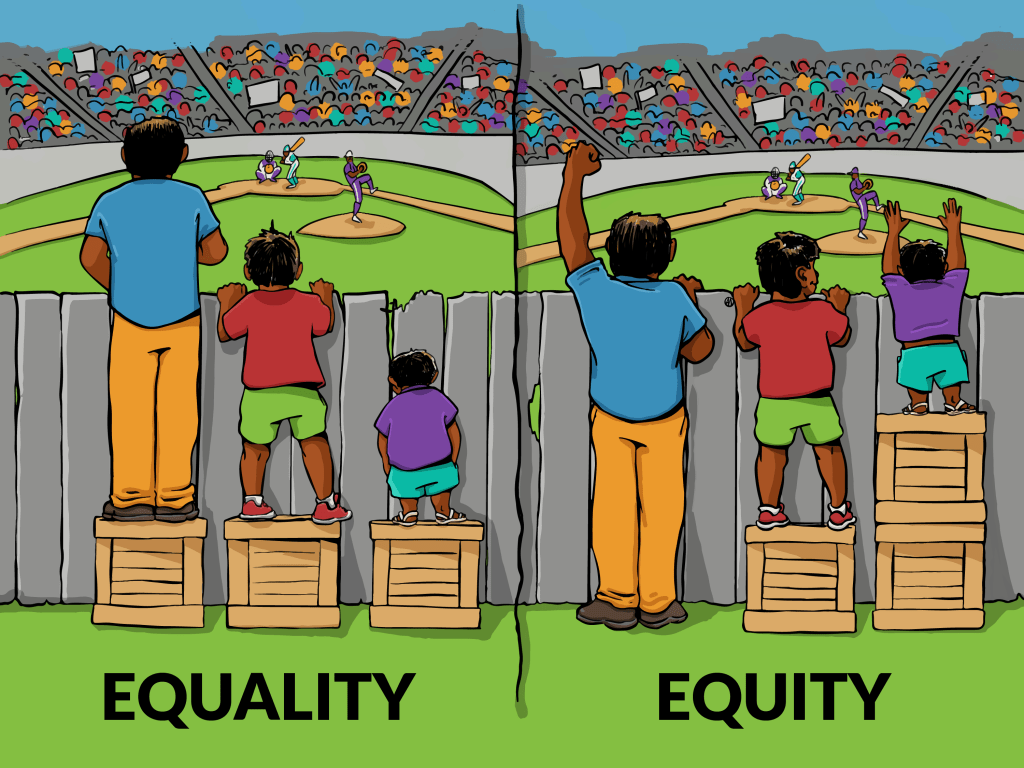
Avarna Group. Starting with a definition by the ‘Avarna Group’, which is a consulting firm that supports the outdoor and environmental sector in their evolution toward diversity, equity, inclusion, and justice (collectively, DEIJ5… “Equity is allocating resources to ensure everyone has access to the same resources & opportunities. Equity recognizes that advantages and barriers—the ‘isms’—exist. Equity is the approach & equality is the outcome.
Friedman et al. (20186). How just and just how? A systematic review of 138 peer-reviewed studies on social equity in conservation research. Environmental Research Letters. Friedman et al. found that equity in conservation centered on themes around: “who decides how conservation will occur, at what cost, and who benefits”. Work by McDermott et al 20137 highlights three dimensions of equity: distribution of costs, responsibilities, rights, and benefits; the procedures, by which decisions are made and who has a voice; and recognition—acknowledgement of and respect for the equal status of distinct identities, histories, values, and interests. These three dimensions are:
- Distribution – evenness of distribution, need, and fairness for financial resources, livelihoods, access, wellbeing.
- Procedure – typically considered involvement in decision making processes.
- Recognition – Recognition of rights, livelihoods, perceptions, culture, knowledge, values.
Additionally, conservation teams recognize that contemporary and historical context matters. McDermott et al 2013 describes this as “the broader social, governance, economic and cultural context, both past and present (e.g. power dynamics, gender, education, ethnicity, age), that influence an actors’ ability to gain recognition, participate indecision-making, and lobby for fair distribution.” Although the literature shows many examples of the broader definition of equity, some research around equity are specific to a particular groups of people based on sexual orientation, gender, race, class, and culture.
For example, several researchers explored Indigenous viewpoints and stories from around the world, including Native American. As shown by a map created by ‘Tribal Nations Map’8, a company owned by members of the Choctaw Nation of Oklahoma, shows the robust number of tribes across the North American continent pre-European around 1000 A.D. For centuries, these tribes stewarded the land in relationship with their environment and much has been lost due to atrocities that nearly eradicated the population, along with cultural and social structures 9. A literature review conducted by Dawson et. al (2021) reviewed 169 peer reviewed papers focused on the role of Indigenous people and local communities in effective and equitable conservation12. Equitable conservation “empowers and supports the environmental stewardship of Indigenous peoples and local communities”. Indigenous perspectives are one of many that have been historically left out of the conservation conversation and off the page.

Courtesy of Aaron Carapella
Acknowledging the Limitation
The available literature is restricted in its ability to speak to nuance and deeply honor the many voices that are represented in the United States. I acknowledge this limitation and will work to avoid overstating and blindly applying research findings.
Going Deeper: From Definitions to the Why
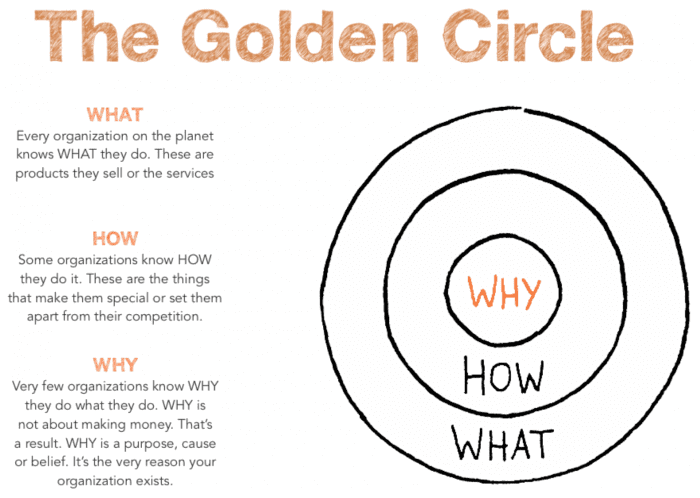
Research into how the U.S. conservation community quickly shows an impressive and vast amount of investment into defining equity. Clear statements about the goal help teams and communities rally around a common vision, but statements are not enough to sustain. As stated by bestselling author Simon Sinek in his 2010 book, ‘Start with Why’13. This more bite sized Ted Talk presented by Sinek sums up his premise quite nicely Start with Why- How Great Leaders Inspire Action. Looking at the core of what moves human behavior, Sinek found that shared purpose can be created to inspire a culture together. Identifying and addressing the inequalities in society requires change and evaluation of how current social dynamics re-inforce inequity. I will spend time in the next post focused on ‘why’ conservation organizations care about equity. See you then!
- Iowa Division of DEI. (2024). Dei definitions. Division of Diversity Equity and Inclusion – The University of Iowa. https://diversity.uiowa.edu/resources/dei-definitions#:~:text=Diversity%20refers%20to%20all%20aspects,%2C%20(dis)ability%2C%20and
↩︎ - Iowa Division of DEI. (2024). Dei definitions. Division of Diversity Equity and Inclusion – The University of Iowa. https://diversity.uiowa.edu/resources/dei-definitions#:~:text=Diversity%20refers%20to%20all%20aspects,%2C%20(dis)ability%2C%20and
↩︎ - Justice, equity, diversity and inclusion. Justice, Equity, Diversity and Inclusion – Public Lands Alliance. (n.d.). https://www.publiclandsalliance.org/about/jedi
↩︎ - Merriam-Webster. (n.d.). Equity definition & meaning. Merriam-Webster. https://www.merriam-webster.com/dictionary/equity?utm_campaign=sd&utm_medium=serp&utm_source=jsonld
↩︎ - About Us. The Avarna Group. (2023b, April 26). https://theavarnagroup.com/about-us/
↩︎ - Friedman, R. S., Law, E. A., Bennett, N. J., Ives, C. D., Thorn, J. P., & Wilson, K. A. (2018). How just and just how? A systematic review of Social Equity in Conservation Research. Environmental Research Letters, 13(5), 053001. https://doi.org/10.1088/1748-9326/aabcde
↩︎ - McDermott, M., Mahanty, S., & Schreckenberg, K. (2013). Examining equity: A multidimensional framework for assessing equity in payments for Ecosystem Services. Environmental Science & Policy, 33, 416–427. https://doi.org/10.1016/j.envsci.2012.10.006
↩︎ - Aaron Carapella. TRIBAL NATIONS MAPS. (n.d.). https://www.tribalnationsmaps.com/
↩︎ - Native Americans ” world without genocide – making it our legacy. World Without Genocide Native Americans Comments. (n.d.). https://worldwithoutgenocide.org/genocides-and-conflicts/american-indian
↩︎ - Dawson, N. M., Coolsaet, B., Sterling, E. J., Loveridge, R., Gross-Camp, N. D., Wongbusarakum, S., Sangha, K. K., Scherl, L. M., Phan, H. P., Zafra-Calvo, N., Lavey, W. G., Byakagaba, P., Idrobo, C. J., Chenet, A., Bennett, N. J., Mansourian, S., & Rosado-May, F. J. (2021). The role of indigenous peoples and local communities in effective and equitable conservation. Ecology and Society, 26(3). https://doi.org/10.5751/es-12625-260319
↩︎ - Sinek, S. (2010). Start with why: How great leaders inspire everyone to take action. Penguin Audio.
↩︎
 Learning That Moves: Advancing Equity in United States Based Conservation

Leave a comment