
Literature Review: What knowledge gaps does study address? Lots of amazing research has been done and how does this effort contribute to what we already know?

Craighead Caverns
Lost Seas Adventure, Sweetwater, TN
Why Equity Matters in Conservation and What it Means? A super brief overview
As climate change worsens, extinction of animals and plants grow, and vulnerable populations become more susceptible to natural hazards and environmental challenges, there is a growing call to understand the nuances and complexities of engaging with, relating to, and/or managing the environment through conservation.
Research on conservation spans several overlapping domains, including learning, knowledge123 and capacity-building, behavior change, conservation history4, and the role of equity in improving socio–ecological outcomes5. The latter, equity, is now widely recognized as central to the legitimacy, durability, and ecological effectiveness of conservation6. Empirical studies demonstrate that, although well-intended, inequitable conservation practices, especially those that perpetuate coercive, top-down approaches, exclude affected communities from decision-making, or marginalize Indigenous and local knowledge7. This dynamic ultimately undermines trust and the community participation that is needed for long-term environmental outcomes891011. Where equity and human rights are sidelined, conservation gains are often short-lived and politically or socially fragile12. Addressing inequities in how conservation benefits and burdens are distributed in a cornerstone for our planet’s wellbeing, not an optional extra13 .
What Does the Research Say about How Equity is Practiced?
Despite broad agreement that equity matters, far less is known about how equitable conservation is enacted in practice, particularly with the U.S. context. Much of the existing literature focuses on naming the problem through frameworks, such as McDermott’s equity framework, which defines the procedural, recognitional, and distributive dimensions of equity1415 . As well as, focusing on the development of tools to support implementation16 and the identification of the historic structural inequalities, power imbalances, and institutional inertia that prevents change in how the sector works 1718. Some research suggests that conservation practitioners and decision makers focus only on surface-level equity interventions while avoiding the deeper structural changes required to address these norms19. A scan of the literature showcases number of case studies (about 150 as of 2017) that demonstrate that individuals and organizations are trying to move the needle on equity and are ardently documenting their efforts2021. Since the mid-2010s, the literature has grown substantially, but systemic documentation remains a research frontier with far fewer studies than other portions of the conservation field, including policy, economics, and biology22
Global Distribution of Conservation Equity Research by Percentage*23
*Based on 138 projects
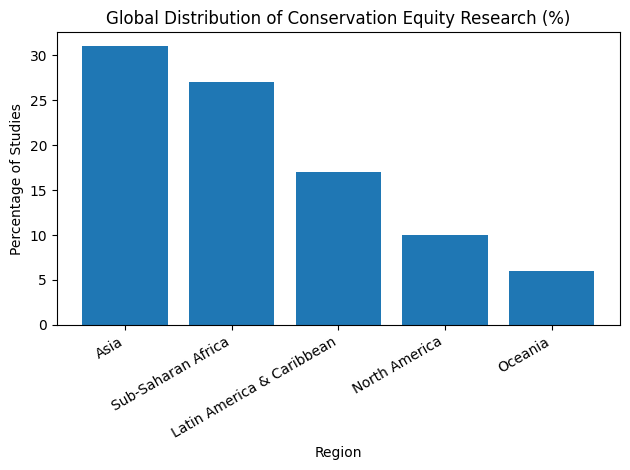
- Asia (31%) and Sub-Saharan Africa (27%) with a strong emphasis on land, water, and community- based governance.
- Latin America and the Caribbean (17%) show a solid focus on livelihoods and incentive-based conservation.
- North American (10%) reflects more localized, institutionally driven research.
- Oceania (6%) highlights a specialized emphasis on marine equity.
Additionally, much of the current research on equitable conservation practices focuses on Africa and Asia, about 60%24. Research show that that conservation equity research is concentrated in these regions, because they contain a high density of protected areas, both terrestrial25 and marine26. Additionally, conservations here is more immediately influenced by global edicts, such as the Convention on Biological Diversity27 (See more details listed below in Figure 1). Lastly, work and expectations are shaped by international funding, which generates built-in evaluation requirements for equity28. A funding dashboard developed by the Pew Charitable Trust, shows that between 2014 and 2024, $7.9B in international funding supported protected and conserved areas across 132 countries, through 3,225 activities reported by 110 organizations29 Conservation interventions in these regions frequently intersect with livelihoods30, land tenure31, Indigenous and local rights32, and historical governance inequities33, making questions of fairness, participation, and benefit distribution especially visible and researchable.
Within the United States, however, research is much more limited with only 10% of conservation equity research. Although, equity commitments are present in the sector, as seen across land trusts34, the evidence on how the conservation sectors moves from equity-oriented understanding to action is thin.
Goals for the Global Aichi Biodiversity Targets
Figure 1.The 20 Aichi Biodiversity Targets set by the Convention on Biological Diversity 35
- Addressing Underlying Causes: Mainstreaming biodiversity across government and society.
- Reducing Direct Pressures: Reducing pollution, managing habitats, and mitigating overexploitation.
- Safeguarding Ecosystems: Protecting 17% of land and 10% of marine areas.
- Enhancing Benefits: Securing ecosystems for food, health, and clean water.
- Implementing Action: Developing national strategies (NBSAPs) to achieve these goals.
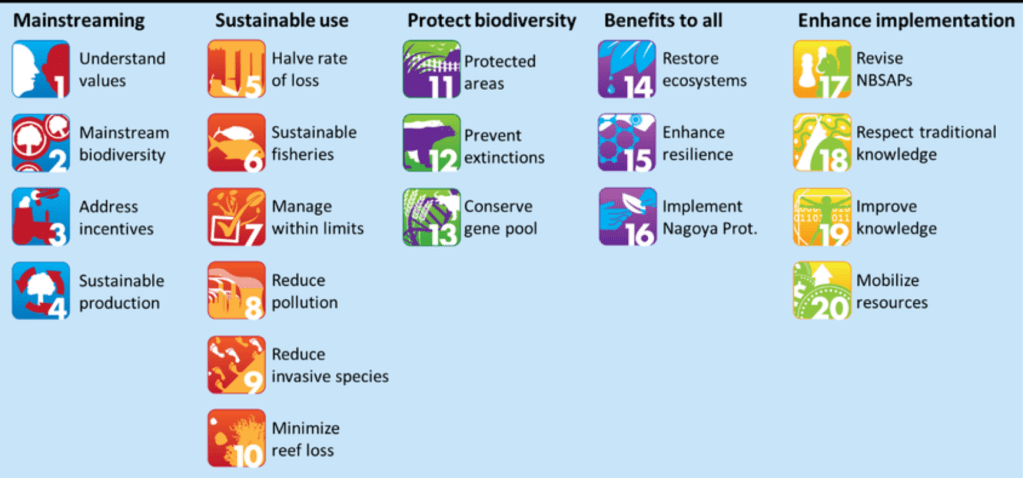
“Target 11: at least 17% of terrestrial and inland water, and 10% of coastal and marine areas, especially areas of particular importance for biodiversity and ecosystem services, are conserved through effectively and equitably managed, ecologically representative and well connected systems of protected areas and other effective area-based conservation measures, and integrated into the wider landscapes and seascapes”
How Does the Literature Frame Learning & Knowledge in implementation of equitable conservation practices?
Much of the existing literature focuses on establishing why equity is a critical component of the conservation business case, examining how equity impacts are measured and the system-level conditions that shape outcomes, such as political structures, institutional inertia, and community resistance. With a lot of focus on the communities and landowners that are adopting conservation practices, however, far less attention is given to the personal experiences of conservation practitioners themselves. I found very limited research addressing this perspective3637, although Bruin et al. (2023) reveals through a study of 144 conservationists found that equity is not or hardly accounted for 50% of efforts. I hold questions about the personal capacities, opportunities, and motivations for conservation practitioners as they evolve their work towards more equitable conservation outcomes.
| To what extent do you perceive equity to be adequately accounted for in today’s global discussions and agreements on nature and agriculture? | Not accounted for | 5 (5.4%) |
|---|---|---|
| Hardly accounted for | 40 (43.5%) | |
| Some aspects accounted for | 36 (39.1%) | |
| Most aspects accounted for | 7 (7.6%) | |
| Fully accounted for | 4 (4.4%) |
Trying to think through all of the ways the information, support, and conditions that are needed for people to feel empowered to be a part of change is incredibly overwhelming. Thankfully behavior change is a well-researched field; an article written by Davis et al 2015 evaluated 82 theories across a variety of behavior and societal fields 39 Of all the options, I am drawn to comprehensiveness and clarity found within the COM-B model. The COM-B model is a behavior change framework that proposes three necessary components for any, behavior (B) to occur. Through assessing capability (C), opportunity (O), and motivation (M) 40, conservation leadership and practitioners can understand and build pathways that help themselves and other have greater impact and ability to influence systems around them.
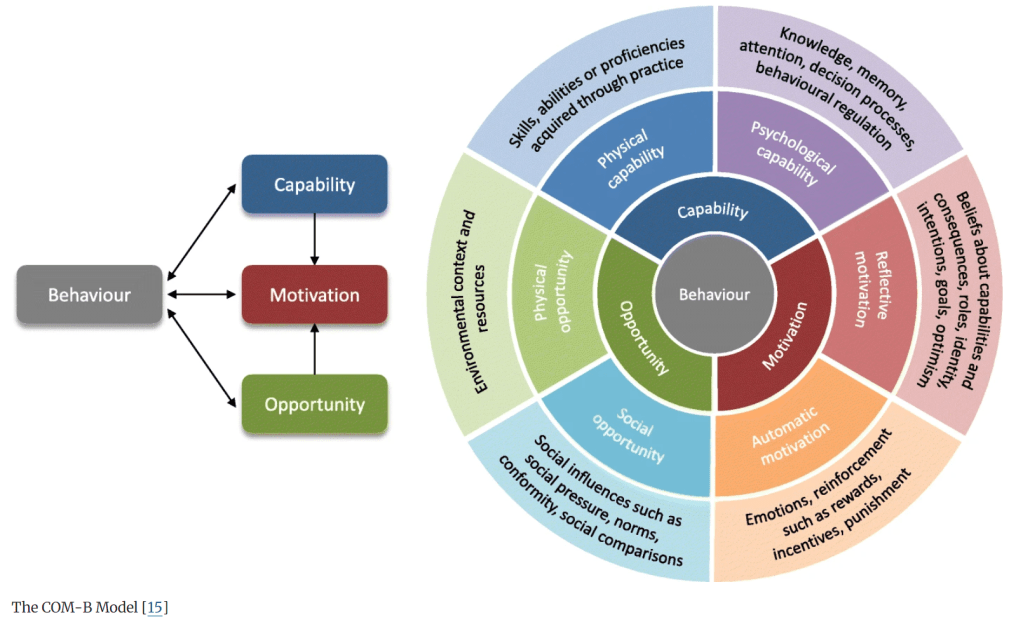
Components of the COM-B Model42
Capacity
Opportunity
Motivation
An individual’s psychological and physical ability to engage in a specific activity:
Physical capability: The physical strength, skill, or stamina needed to perform a behavior.
Psychological capability: The knowledge, cognitive abilities, and mental skills required.
All external factors that make a behavior possible or prompt it:
Physical opportunity: What the environment enables through time, resources, locations, and physical cues.
Social opportunity: The cultural norms, social expectations, and interpersonal influences that shape our actions
The internal processes that energize and direct behavior:
Reflective motivation: Conscious decision-making processes involving plans, evaluations, and beliefs
Automatic motivation: Emotional responses, habits, impulses, and desires that drive behavior without conscious thought.
Of the six components with the COM-B model, this study will look at how ‘psychological capacity’, specifically learning and knowledge, and its relationship to the other components, influences practitioners’ ability to initiate more equitable conservation practices. Learning is frequently positioned as a key mechanism for advancing equity through training, professional development, and capacity-building. However, research across behavioral science and environmental education consistently shows that learning alone rarely produces sustained behavior change. Conservation initiatives often overinvest in knowledge provision while under addressing the motivational, social, and structural conditions necessary for action. This has created a recognized gap in the literature on the learning–justice nexus. As noted by Dilay et al., there is a dearth of empirical research examining how learning outcomes actually contribute to justice and equity in environmental policy and practice, or how learning interacts with other determinants of action43.
This study advances the field of conservation social science by bringing together these three strands of research with limited integration: behavioral drivers (COM-B), learning processes, and equity in conservation practice. By focusing on how capacity, opportunity, and motivation shape the ability of people to accelerate equitable conservation outcomes, and on the role of learning relative to these dynamics, this research offers novel insights on both theory and practice. Ideally, this research supports conservation organizations in their ability to support staff and test assumptions about how equitable conservation can be supported.
References
- Moreau, M.-A., & Woodhouse, E. (2025). Improving transparency in conservation social science research to enhance quality, equity, and collaboration. Conservation Biology, 39(2), e70003. https://doi.org/10.1111/cobi.70003 ↩︎
- Eriksen, S. H., Nightingale, A. J., & Eakin, H. (2015). Reframing adaptation: The political nature of climate change adaptation. Global Environmental Change, 35, 523–533. https://doi.org/10.1016/j.gloenvcha.2015.09.014
↩︎ - Eriksen, S. H., Nightingale, A. J., & Eakin, H. (2015). Reframing adaptation: The political nature of climate change adaptation. Global Environmental Change, 35, 523–533. https://doi.org/10.1016/j.gloenvcha.2015.09.014 ↩︎
- Morales, N., Lee, J., Newberry, M., & Bailey, K. (2023). Redefining American conservation for equitable and inclusive social-environmental management. Ecological Applications, 33(1), e2749. https://doi.org/10.1002/eap.2749 ↩︎
- Bennett, N. J., Roth, R., Klain, S. C., Chan, K., Christie, P., Clark, D. A., Cullman, G., Curran, D., Durbin, T. J., Epstein, G., Greenberg, A., Nelson, M. P., Sandlos, J., Stedman, R., Teel, T. L., Thomas, R., Veríssimo, D., & Wyborn, C. (2017). Conservation social science: Understanding and integrating human dimensions to improve conservation. Biological Conservation, 205, 93–108. https://doi.org/10.1016/j.biocon.2016.10.006 ↩︎
- Dawson, N. M., Coolsaet, B., Sterling, E. J., Loveridge, R., Gross-Camp, N. D., Wongbusarakum, S., Sangha, K. K., Scherl, L. M., Phan, H. P., Zafra-Calvo, N., Lavey, W. G., Byakagaba, P., Idrobo, C. J., Chenet, A., Bennett, N. J., Mansourian, S., & Rosado-May, F. J. (2021). The role of Indigenous peoples and local communities in effective and equitable conservation. Ecology and Society, 26(3), Article 19. https://doi.org/10.5751/ES-12625-260319 ↩︎
- Duffy, R., Massé, F., Smidt, E., Marijnen, E., Büscher, B., Verweijen, J., Ramutsindela, M., Simlai, T., Joanny, L., & Lunstrum, E. (2019). Why we must question the militarisation of conservation. Biological Conservation, 232, 66–73. https://doi.org/10.1016/j.biocon.2019.01.013
↩︎ - Massé, F., & Lunstrum, E. (2016). Accumulation by securitization: Commercial poaching, neoliberal conservation, and the creation of new wildlife frontiers. Geoforum, 69, 227–237. https://doi.org/10.1016/j.geoforum.2015.03.005
↩︎ - Butt, N., Chauvenet, A. L. M., Adams, V. M., Beger, M., Gallagher, R. V., Shanahan, D. F., Ward, M., Watson, J. E. M., & Possingham, H. P. (2020a). Importance of species translocations under rapid climate change. Conservation Biology, 35(3), 775–783. https://doi.org/10.1111/cobi.13643
↩︎ - López‐Cubillos, S., Muñoz‐Ávila, L., Roberson, L. A., Suárez‐Castro, A. F., Ochoa‐Quintero, J. M., Crouzeilles, R., Gallo‐Cajiao, E., Rhodes, J., Dressler, W., Martinez‐Harms, M. J., & Runting, R. K. (2021). The landmark escazú agreement: An opportunity to integrate democracy, human rights, and transboundary conservation. Conservation Letters, 15(1). https://doi.org/10.1111/conl.12838
↩︎ - Montgomery, R. A., Kabra, A., Kepe, T., Garnett, S., & Merino, R. (2024). Re-centering social justice in conservation science: Progressive policies, methods, and practices. Biological Conservation, 294, 110600. https://doi.org/10.1016/j.biocon.2024.110600
↩︎ - Pörtner, H.-O., Scholes, R. J., Arneth, A., Barnes, D. K. A., Burrows, M. T., Diamond, S. E., Duarte, C. M., Kiessling, W., Leadley, P., Managi, S., McElwee, P., Midgley, G., Ngo, H. T., Obura, D., Pascual, U., Sankaran, M., Shin, Y. J., & Val, A. L. (2023). Overcoming the coupled climate and biodiversity crises and their societal impacts. Science, 380(6642). https://doi.org/10.1126/science.abl4881 ↩︎
- McDermott, M., Mahanty, S., & Schreckenberg, K. (2013). Examining equity: A multidimensional framework for assessing equity in payments for ecosystem services. Environmental Science & Policy, 33, 416–427. https://doi.org/10.1016/j.envsci.2012.10.006 ↩︎
- Cheng, Y. D., Yang, L., & Deng, S. (2022). Nonprofit density and distributional equity in public service provision: Exploring racial/ethnic disparities in public park access across U.S. cities. Public Administration Review, 82(3), 473–490. https://doi.org/10.1111/puar.13465 ↩︎
- Schreckenberg, K., Franks, P., Martin, A., & Lang, B. (2016). Unpacking equity for protected area conservation. PARKS: The International Journal of Protected Areas and Conservation, 22(2), 11–28. https://doi.org/10.2305/IUCN.CH.2016.PARKS-22-2KS.en ↩︎
- Gould, R. K., Phukan, I., Mendoza, M. E., & Ardoin, N. M. (2018). Seizing opportunities to diversify conservation. Conservation Letters, 11(4), e12431. https://doi.org/10.1111/conl.12431 ↩︎
- Beckman, C. M., Wheaton, M., Sawe, N., & Ardoin, N. M. (2023). Incorporating justice, equity, and Access Priorities Into Land Trusts’ conservation efforts. Biological Conservation, 279, 109926. https://doi.org/10.1016/j.biocon.2023.109926 ↩︎
- Hampton-Smith, M., Gurney, G. G., Morrison, T. H., & Cinner, J. E. (2024). Equity in global conservation policy varies in clarity and comprehensiveness. One Earth, 7(11), 1970–1980. https://doi.org/10.1016/j.oneear.2024.09.018 ↩︎
- Michels, K. (2021, December 21). Placing fairness at the root: Three case studies in conservation finance justice. Conservation Finance Network. https://www.conservationfinancenetwork.org/2021/12/21/placing-fairness-at-the-root-three-case-studies-in-conservation-finance-justice ↩︎
- Bateson, E., Conover, B., & Gonzalez-Aller, A. (2021). Weaving the strands together: Case studies in inclusive and equitable landscape conservation (Report). Salazar Center for North American Conservation, Colorado State University; Network for Landscape Conservation; Center for Large Landscape Conservation. https://salazarcenter.colostate.edu/wp-content/uploads/sites/12/2021/01/Weaving-the-Strands-Together_Case-studies-in-inclusive-and-equitable-landscape-conservation.pdf ↩︎
- Hampton-Smith, M., Gurney, G. G., Morrison, T. H., & Cinner, J. E. (2024). Equity in global conservation policy varies in clarity and comprehensiveness. One Earth, 7(11), 1970–1980. https://doi.org/10.1016/j.oneear.2024.09.018 ↩︎
- Friedman, R. S., Law, E. A., Bennett, N. J., Ives, C. D., Thorn, J. P. R., & Wilson, K. A. (2018). How just and just how? A systematic review of social equity in conservation research. Environmental Research Letters, 13(5), 053001. https://doi.org/10.1088/1748-9326/aabcde ↩︎
- Oldekop, J. A., Holmes, G., Harris, W. E., & Evans, K. L. (2016). A global assessment of the social and conservation outcomes of protected areas. Proceedings of the National Academy of Sciences, 113(5), 1236–1241. https://doi.org/10.1073/pnas.1523482113 ↩︎
- Chen, Q., Zhang, Y., Zhang, Y., & Kong, M. (2022). Examining social equity in the co-management of terrestrial protected areas: Perceived fairness of local communities in Giant Panda National Park, China. Land, 11(10), 1624. https://doi.org/10.3390/land11101624 ↩︎
- Bennett, N. J., & Dearden, P. (2014). Why local people do not support conservation: Community perceptions of marine protected area livelihood impacts, governance and management in Thailand. Marine Policy, 44, 107–116. https://doi.org/10.1016/j.marpol.2013.08.017 ↩︎
- Zafra-Calvo, N., Garmendia, E., Pascual, U., Palomo, I., Gross-Camp, N., Brockington, D., Cortes-Vázquez, J.-A., Coolsaet, B., & Burgess, N. D. (2019). Progress toward equitably managed protected areas in Aichi Target 11: A global survey. BioScience, 69(3), 191–197. https://doi.org/10.1093/biosci/biy143 ↩︎
- Global Conservation. (n.d.). Global Conservation: Protecting the world’s wildest places through park defense and community programs. https://globalconservation.org/ ↩︎
- Pew Charitable Trust. 30×30 Funding: International funding overview for protected and conserved areas. https://www.30x30funding.com/ ↩︎
- CBD. 2022. Conference of the parties to the convention on biological diversity fifteenth meeting Part II, Montreal, Decision 15/4: The Kunming-Montreal Global biodiversity framework. https://www.cbd.int/doc/decisions/cop-15/cop-15-dec-04-en.pdf. ↩︎
- Allan, J.R., H.P. Possingham, S.C. Atkinson, A. Waldron, M. Di Marco, S.H.M. Butchart, V.M. Adams, W.D. Kissling, et al. The minimum land area requiring conservation attention to
safeguard biodiversity. Science 376: 1094–1101. https://doi.org/10.1126/science.abl9127. ↩︎ - Langhammer, P.F., J.W. Bull, J.E. Bicknell, J.L. Oakley, M.H. Brown, M.W. Bruford, S.H.M. Butchart, J.A. Carr, et al. 2024. The positive impact of conservation action. Science 384:
453–458. https://doi.org/10.1126/science.adj6598. ↩︎ - Dawson, N.M., Coolsaet, B., Bhardwaj, A. et al. Reviewing the science on 50 years of conservation: Knowledge production biases and lessons for practice. Ambio 53, 1395–1413 (2024). https://doi.org/10.1007/s13280-024-02049-w ↩︎
- Beckman, C. M., Wheaton, M., Sawe, N., & Ardoin, N. M. (2023). Incorporating justice, equity, and access priorities into land trusts’ conservation efforts. Biological Conservation, 279, Article 109926. https://doi.org/10.1016/j.biocon.2023.109926B ↩︎
- https://www.researchgate.net/profile/Michael-Vardon/publication/334067489/figure/fig2/AS:11431281082226908@1662005873649/The-20-Aichi-Biodiversity-Targets-set-by-the-CBD.ppm ↩︎
- Future Conservation. (n.d.). Future Conservation. https://www.futureconservation.org/ ↩︎
- Crosman, K. M., Jurcevic, I., Van Holmes, C., Hall, C. C., & Allison, E. H. (2022). An equity lens on behavioral science for conservation. Conservation Letters, 15(3), e12885. https://doi.org/10.1111/conl.12885 ↩︎
- de Bruin, S. P., van Vliet, J., Lehmann, I., & Verburg, P. (2023). Perceptions of equity in conservation scenarios: Half Earth and Sharing the Planet. Environmental Science & Policy, 144, 124–136. https://doi.org/10.1016/j.envsci.2023.03.015 ↩︎
- Davis, R., Campbell, R., Hildon, Z., Hobbs, L., & Michie, S. (2015). Theories of behaviour and behaviour change across the social and behavioural sciences: A scoping review. Health Psychology Review, 9(3), 323–344. https://doi.org/10.1080/17437199.2014.941722 ↩︎
- De Leo, A., Bayes, S., Bloxsome, D. et al. Exploring the usability of the COM-B model and Theoretical Domains Framework (TDF) to define the helpers of and hindrances to evidence-based practice in midwifery. Implement Sci Commun 2, 7 (2021). https://doi.org/10.1186/s43058-020-00100-x ↩︎
- Bowden FJ, Currie MJ, Toyne H, McGuiness C, Lim LL, Butler JR, Glasgow NJ. Screening for Chlamydia trachomatis at the time of routine Pap smear in general practice: a cluster randomised controlled trial. Med J Aust. 2008;188:76-80. ↩︎
- Ridley-Moy, D. (n.d.). COM-B Behaviour Change Framework. Behaviour Change Network. Retrieved February 8, 2026, from https://www.behaviourchangenetwork.com/post/com-b-behavioural-framework/ ↩︎
- Dilay, Arianea; Sinclair, A. Johna; Diduck, Alan P.b; Gardner, Jamesa. Participation, Learning and Environmental Justice: A Case Study of Protected Area Planning and Management in the Kullu District of Himachal Pradesh, India. Conservation and Society 22(1):p 37-48, Jan–Mar 2024. | DOI: 10.4103/cs.cs_23_23 ↩︎
 Learning That Moves: Advancing Equity in United States Based Conservation
Leave a comment