
Literature Review Part 5: How does existing research detail how people initiate and maintain behavior change? How does learning and knowledge show up as a key driver in making things happen?
The purpose of the literature review is to establish the current state of knowledge on a particular topic, identify gaps in the existing research, and highlight areas where further research is needed.

When was the last lesson that didn’t just inform you, but compelled you to move?
Emerald Lake, Yoho Lake, Field, BC, Canada
The value of a theoretical framework
So Many Perspectives, One Foundation of Understanding.
We all have unique lived experiences that shape how we see the world. These unique perspectives mean that two people can experience the same moment with varying emotion, mental, and physical responses. In qualitative research, this is both a superpower and a constraint. Learning from each individual is what makes qualitative research rich, meaningful, and honoring of human complexity1 (1). However, without a shared theoretical or analytical framework to guide data collection and interpretation it can be tough to build cumulative generalized knowledge in ways that others can compare, extend, and replicate, if desired.
What is a theoretical framework?
As described by Tess Tsindos “A framework is a set of broad concepts or principles used to guide research. As described by Varpio and colleagues3, a framework is a logically developed and connected set of concepts and premises, developed from one or more theories, that a researcher uses as a scaffold for their study4. Even with this well-crafted definition, I’ve personally had a heckuva time wrapping my head around what a theoretical framework even does and why it matters. After lots of churning, it came to me like a bolt of lightning while standing in the kitchen and trying to explain it to my husband. Hopefully my revelation is helpful to you as well!
For example, think of a big window that looks out on a backyard and its many bird feeders. If asked to describe the health of the yard, we’ll notice different things. One person might point out how lush the grass looks, while the other sees grass that offers no wildlife benefit. A theoretical framework helps mitigate confusion i.e. appearance of the backyard versus its ecosystem function, by setting boundaries on perspective. Both speak to the “health of the backyard,” but from very different ideologies (Reference: myself!). The framework gives researchers, interviewees, and readers a shared lens for understanding how the research question was approached. It also makes it possible for us to understand complex, human thinking in practical terms that can be applied to across every industry and physical environments.
Introducing COM-B: A Widely Used Framework
This study uses the COM-B framework to examine the factors that influence how people take action to increase equity in conservation and where learning fits in the puzzle. Developed by Michie, van Stralen, and West (2011), COM-B emerged from an effort to synthesize the growing number of behavior change theories into a single, practical framework that could be applied across disciplines. At the time, behavioral science offered dozens of competing theories, each emphasizing different determinants of behavior. COM-B integrated these perspectives into a model centered on three interacting components: Capability, Opportunity, and Motivation, which together shape Behavior. Rather than assuming a single cause of behavior, the framework provides a systematic way to identify the conditions that enable or constrain action and to target interventions accordingly. Honestly, it couldn’t be more perfect for this study and its research aims. So how is the acronym COM-B more deeply defined?

Capability
(C): The physical and psychological ability to perform the behavior.
More Specifically
- Physical: Skills, strength, physical resources.
- Psychological: Knowledge, understanding, cognitive skills.

Opportunity
(O): External factors that make the behavior possible or impossible.
More Specifically
- Physical: Access to tools, environment, time.
- Social: Social norms, cultural influences, support systems.

Motivation
(M): Internal processes that direct and energize behavior.
More Specifically
- Reflective: Conscious beliefs, values, intentions (e.g., wanting to be healthy).
- Automatic: Instincts, emotions, habits, impulses (e.g., craving sugar).
Behavior (B):
“The action itself, which requires all three C, O, & M to be present”
For a more detailed glossary, clink here
What does COM-B look in practice?
One of the reasons COM-B has become so widely used is that it helps move beyond asking, “Why aren’t people doing this?” Instead, it asks, “What’s getting in the way?” Researchers and practitioners use the framework to identify whether a behavior is limited by capability, opportunity, or motivation. That diagnosis makes it easier to design interventions that match the real barrier. If people lack knowledge or skills, education or training may be the answer. If the environment makes the behavior difficult, changing policies, incentives, or social norms may be more effective. If motivation is the challenge, strategies like persuasion, modeling, or habit formation may be needed.
COM-B sits at the center of the Behavior Change Wheel (figure 2 is below), a companion framework that links these behavioral barriers to evidence-based intervention strategies. Together, they provide a practical roadmap for moving from understanding behavior to designing actions that support meaningful and lasting change.
Take wearing a bicycle helmet as a simple example. If someone doesn’t know how to adjust a helmet correctly, the barrier is capability. If helmets are expensive, unavailable, or no one else in their community wears one, the barrier is opportunity. If they don’t believe helmets improve safety or they’ve never developed the habit of wearing one, the barrier is motivation. Each situation calls for a different solution, which is exactly what makes the COM-B framework so useful in practice.
Intervention Functions (9 in Dark Purple)
- Persusuasian
- Incentivation
- Coercion
- Training
- Engagement
- Modelling
- Environmental Restructuring
- Restrictions
- Education
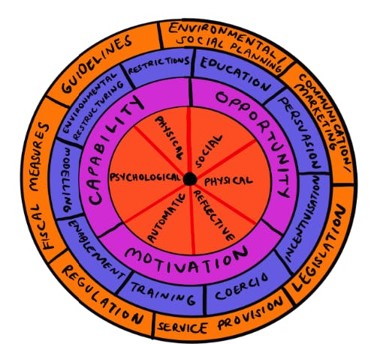
In addition to the nine intervention functions, Michie, Atkins, & West identified seven policy functions (in the outer ring of orange in the graphic above). These are: Guidelines; Fiscal Measures; Regulation; Service Provision; Legislation; Communication/Marketing, and; Environmental Social Planning.
How is conservation research using this framework?
The COM-B framework is widely used to understand how people make decisions and take action. It helps researchers, practitioners, and evaluators identify where to begin by focusing on the factors most likely to influence behavior.
Its adoption in conservation has been remarkable, especially given how new the framework is. When I started my first social science research project in 2012, COM-B had been published only a year earlier. Since then, it has been applied across studies on agricultural best management practices, household resource use, animal welfare, and many other topics. A few examples are included below. The framework also works well with both qualitative and quantitative research, making it a flexible tool for conservation research and practice.
| Study Name and Authors | Study Purpose | Framework Presentation? | Link |
| “Promoting sustainable behavior: addressing user clusters through targeted incentives” Hopfl et. al8 | Explore how individuals differ in sustainability values, beliefs, attitudes, and actions with a goal to develop and refine interventions for behavior change. | Used as one of several behavioral frameworks to structure thinking and demonstrate mulit-faceted personal and social factors influencing behavior. | Link |
| “Development and validation of… Framework to assess farmers’ mindsets in relation to animal welfare, environmental conservation, and their subjective wellbeing” Naydani et al (2024)9 | Explore how increase demand for animal products may create unethical treatment of animals without intervention. | Used as one of two behavioral frameworks to farmers mindsets related to animal welfare and environmental health | Link |
| “Motivation Without Means? Behavioral Drivers and Barriers to Biodiversity Implementation on Dutch Equine Yards” Wolffram et al. (2026)11 | This study explored behavioral drivers and barriers to biodiversity implementation on Dutch equine yards. | Used to understand landowner decision making and served as the reference for analyzing qualitative interview data. | Link |
| Growing change: Promoting insect-friendly behaviour through gardening-framed interventions” Niess, et al. (2026)12 | This study explores individuals’ attitudes, behaviors, and interventions towards declining insect populations that are critical to pollination, food systems, and ecosystems | Demonstrated how behavior change frameworks such as COM-B can be operationalized in real-world and multifaceted biodiversity and insect campaigns. | Link |
| “Household Water Use and Conservation Behavior: A Meta-Analysis” Addo, Thoms, Parsons (2018)13 | This study explores decision-making behind household water consumption | Qualitative survey based on com-b model to understand behavior | Link |
What will applying a theoretical framework look like in this study?
This study aims to learn from at least 50 people through one-hour semi-structured interviews. This is an incredible amount of data. U.S. English speakers speak on average around 150 words a minute13, which translates to 9.000 words in an hour equating to 18 pages typed single space. Multiple that 50 times over and I’ll be blessed with 900 pages of research material. A theoretical frame, such as COM-B and its 3 decision factors, 9 intervention points, and 7 policy options gives me a blueprint that establishes the rules, concepts, and scope of data interpretation and organization. Additionally it allows other to recreate, repeat, and test the study in their own contexts using a similar foundation. This adds long-term credibility to the study’s results.
references
- Varpio L, Paradis E, Uijtdehaage S, Young M. The distinctions between theory, theoretical framework, and conceptual framework. Acad Med. 2020;95(7):989-994. doi:10.1097/ACM.0000000000003075 ↩︎
- PolyEast Records. (2021, October 16). Joey Albert & Pops Fernandez – Points of view (Official lyric video) [Video]. YouTube. https://www.youtube.com/watch?v=nmw_Jp8lT94
↩︎ - Tenny, S. (2022, September 18). Qualitative study. StatPearls [Internet]. https://www.ncbi.nlm.nih.gov/books/NBK470395/ ↩︎
- Tsindos, T. (2023, March 21). Chapter 4: Theoretical frameworks for qualitative research. Qualitative Research – a practical guide for health and social care researchers and practitioners. https://oercollective.caul.edu.au/qualitative-research/chapter/4/ ↩︎
- Capacity icons created by Magnific – Flaticon ↩︎
- Carrier icons created by alkhalifi design – Flaticon ↩︎
- Motivation icons created by Magnific – Flaticon ↩︎
- Michie, S., Atkins, L., & West, R. (2014). The Behaviour Change Wheel: A Guide to Designing Interventions. London: Silverback Publishing. Official Book Website ↩︎
- Höpfl, L., Grimlitza, M., Lang, I. et al. Promoting sustainable behavior: addressing user clusters through targeted incentives. Humanit Soc Sci Commun 11, 1192 (2024). https://doi.org/10.1057/s41599-024-03581-6 ↩︎
- Naydani, C. J., Jessiman, L., & Jarvis, S. (2024). Development and validation of a tool using the COM-B model of behaviour change and Theoretical Domains Framework to assess farmers’ mindsets in relation to animal welfare, environmental conservation, and their subjective wellbeing. PsychArchives. https://doi.org/10.23668/psycharchives.15452 ↩︎
- Wolframm, I., Arrabal, D., van den Brink, E., & Korterink de Vries, J. (2026). Motivation Without Means? Behavioral Drivers and Barriers to Biodiversity Implementation on Dutch Equine Yards. Conservation, 6(1), 4. https://doi.org/10.3390/conservation6010004 ↩︎
- Niess, S., Schneider, F., Pauls, S. U., Schuch, S., & Mehring, M. (2026). Growing change: Promoting insect-friendly behaviour through gardening-framed interventions. Biological Conservation, 313, 111565. https://doi.org/10.1016/j.biocon.2025.111565
↩︎ - Addo, I. B., Thoms, M. C., & Parsons, M. (2018). Household water use and conservation behavior: A meta-analysis. Water Resources Research, 54, 8381–8400. https://doi.org/10.1029/2018WR023306 ↩︎
- Yoo J, Oh H, Jeong S, Jin IK. Comparison of Speech Rate and Long-Term Average Speech Spectrum between Korean Clear Speech and Conversational Speech. J Audiol Otol. 2019 Oct;23(4):187-192. doi: 10.7874/jao.2019.00115. Epub 2019 Jul 20. PMID: 31319638; PMCID: PMC6773961. ↩︎


Leave a comment